
The stock that moves but never gets recorded
There’s a pattern that repeats itself across installation companies. At the start of the day, workers go to the warehouse, pick up what they need for the day’s jobs, load the van, and hit the road. So far, so good.
The problem is what doesn’t happen next: that stock movement never gets recorded. Not because no one asked for it, and not because there’s no software to do it. It doesn’t get recorded because between finishing the load and already being on the way to the first client, there’s no time. And when there’s no time, the entry gets pushed to later. And later never comes.
It’s not a software problem
This is an important point: most of these companies already have some kind of stock management system. The problem isn’t that a tool is missing — it’s that the existing tool creates too much friction to use in that moment.
Logging a stock transfer in a traditional system means:
- opening the app or web portal
- searching for each reference manually
- entering the quantity
- selecting the destination
- confirming the operation
If you have to do that for fifteen items while your colleague has already started the engine, you simply don’t do it. Not today, not tomorrow.
The friction isn’t just technical. It’s contextual. The worker is in physical mode, not administrative mode. What they need is a way to capture that information within their own context — without switching modes, without losing time, without sitting down at a screen.
The real cost of unrecorded stock
When stock movements go unlogged, the consequences pile up quietly:
- the company doesn’t know what’s in each van at any given moment
- it can’t compare warehouse stock against what has actually been consumed
- materials used on-site frequently don’t make it onto the client invoice
- parts are “somewhere around” but nobody knows exactly where
- the back office can’t close the month with reliable figures
The worst problem, and the least visible, is billing. Many installers consume materials at a client’s site and that material never appears on the invoice. Not out of bad faith, but because the information flow between the field and the office has too many steps and too much delay.
That unbilled material is a direct loss. It’s also a signal of disorganisation that, over time, erodes the company’s profitability and reputation.
How Voice Search works in TicTAP
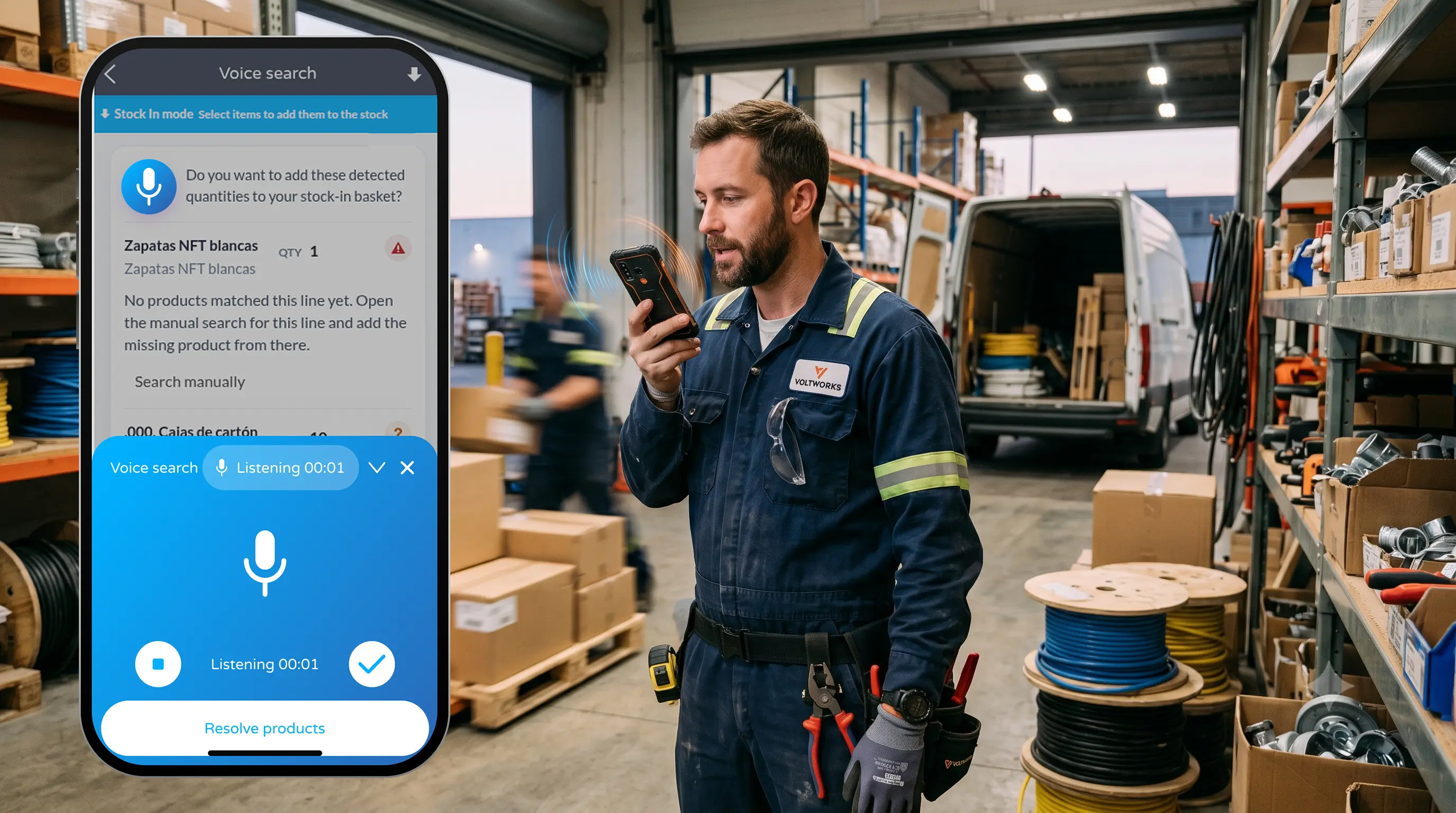
Voice Search is TicTAP’s feature that lets you log stock operations using only your voice.
The worker speaks: they describe what they want to do and with which material. The system transcribes the message, automatically identifies the items in the warehouse catalogue, and proposes the correct operation. The user confirms and the movement is recorded.
The operations available by voice are:
- stock in: material entering the warehouse
- stock out: material leaving the warehouse
- stock transfer: transfer between locations, for example from the warehouse to a van
- stock adjust: inventory adjustment when there are discrepancies between expected and actual figures
All without searching for references manually, without navigating menus, without interrupting the physical flow of work.
What changes day to day
The difference isn’t only about speed. It’s about feasibility.
Before Voice Search, logging a van’s stock at the start of the day was a task that required willpower, time, and an administrative mindset. With this feature it can be done right in the warehouse, at the exact moment the goods are loaded, phone in hand.
That has an immediate effect on communication between installers and the back office. When stock movements are logged in real time, the office knows what’s happening. It can track consumed material. It can close budgets with real figures. It can invoice accurately.
And the worker no longer carries the pending task of “log the stock when I get a moment.” That moment already happened, in the warehouse, while loading.
One piece inside the TicTAP ecosystem
Voice Search isn’t a standalone feature. It’s part of TicTAP’s logic, which connects physical assets, field operations, traceability, and management in a single platform.
Alongside tools like Asset Passport, the stock module, preventive maintenance, and inspections, Voice Search adds a fast-capture layer that complements everything already in place:
- every asset has a profile, history, and traceability
- every stock item has a location, movement log, and inventory control
- inspections have checklists and compliance tracking
- and now, stock movements can be logged by voice, at the moment the material physically moves
TicTAP’s goal is for the worker to document their work well without documentation competing with work. Voice Search is a direct expression of that principle — designed from the ground up, thinking about the installer’s daily routine, not the system it needs to feed.
Want to see it in your warehouse?
If your team heads out every morning without logging what they’ve loaded, the problem isn’t discipline. It’s the flow. And that flow can be fixed.